Meet the creators of Hell Yeah! The Horror of the Bible
I recently visited Church of the Advent in Walnut Hills, a neighborhood in Cincinnati right around the corner from Forward Movement’s headquarters. I had the chance to chat with the rector Dan Carlson, as well as minister for arts, media, and community Jacob Taylor, and local artist Joey Joseph about art and faith, community engagement, the Bible, horror movies, and how their church is sharing itself through creative initiatives. We focused mostly on their comic book style zine series called Hell Yeah!: The Horror of the Bible, which is now available from Forward Movement and just published its fifth volume. As you’ll hear, they’re combining this creative medium with, quoting Dan, “the idea of making everything in the Bible talk about-able.”
Listen to our conversation here, or read on for the transcript. You can learn more about Hell Yeah! at forwardmovement.org/zines. And just to note, even though they are comic books, they are meant for older teens and adults.
– Jason Merritt, Director of Marketing & Partnerships
[Appropriately for a conversation about darker subjects of the Bible, a rain storm descended on us midway through the interview, so apologies for the white noise invading the conversation a few minutes in.]
Jason
Greetings, I’m here at Church of the Advent in Walnut Hills, which is a neighborhood in Cincinnati, Ohio. And I am here with Jacob (Taylor), Dan (Carlson), and Joey (Joseph), who are the brains behind the Advent Workshop, which we’ll talk a little bit more about in a minute, as well as a new partnership for Forward Movement.
Hell Yeah!, the comic book zines series that you guys have been producing for several years— Forward Movement is now going to be releasing those on our website and people will have access to them beyond just Church of the Advent. So welcome. Thank you, guys, for being with us today.
Dan
Thanks for having us.
Jason
So, tell us a little bit about Church of the Advent. Give us an overview of the church itself and how you guys came to be here.
Dan
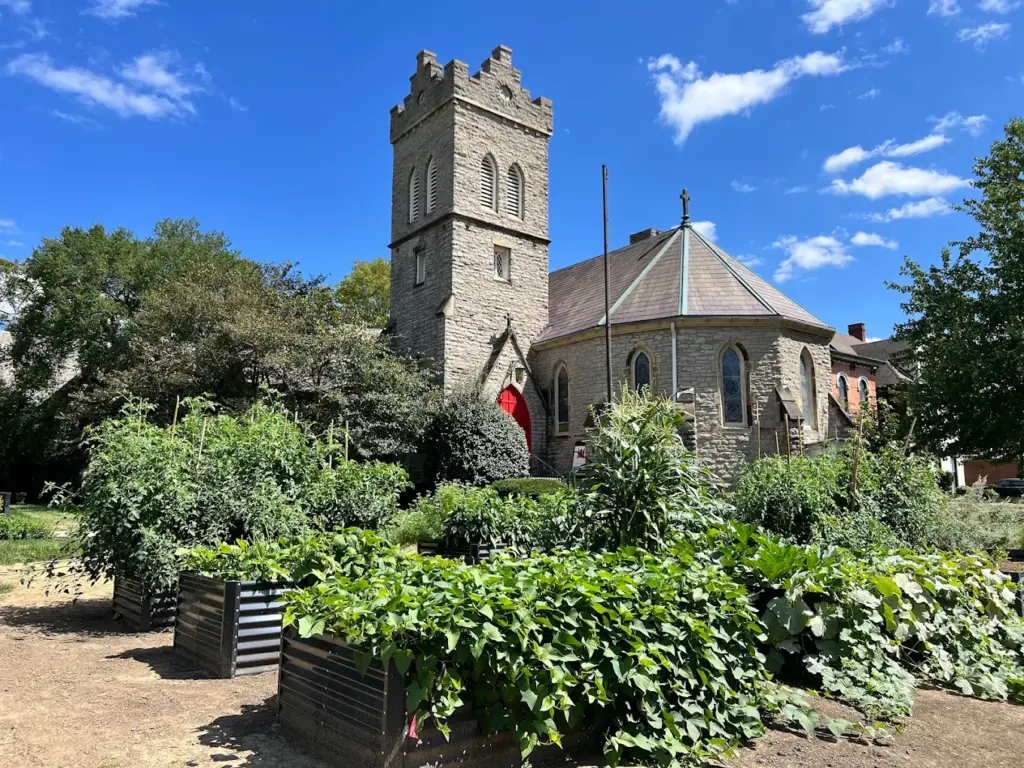
Well, I’m the priest here, but I’ve only been the priest here for a little over three years. So, I think everybody else connected after me at some point. So, we’re relatively new, but Church of the Advent is quite old. It was founded in 1855, so it’s one of the older parishes in Cincinnati. And there’s a lot of history we inherited when we came here, but really the story of the last few years has been about rethinking the way that we show up in the world, how we want to gather community, how we go about communicating with the broader world. And so, everybody else has sort of been invited in as part of that project.
Jason
Tell us a little bit about yourselves. I’m going to start—well, Dan, we’ll start with you. You’re already speaking. So, tell us a little bit about where you’re from.
Dan
Yeah, I’m born and bred in Cincinnati. So if you cut me, I bleed Cincinnati red. I have been in Cincinnati most of my life, although I did seminary out on the West Coast and stayed out on the West Coast for a couple of years before I came back.
Jason
And Jacob?
Jacob
Yeah, I’m also a native Cincinnatian. I grew up in the northern suburbs. Been in Cincinnati most of my life, spent a lot of my 20s kind of living on the road. I eventually went to Columbus for a couple years to do grad school at the Methodist Theological Seminary in Ohio. Moved back here now about five years ago, and I’ve been the minister for arts, media, and community at Church of the Advent now for coming up on three years in November.
Jason
Wonderful, wonderful. And Joey?
Joey
Yeah, I grew up in Defiance, Ohio, and have been drawing and making art and stuff and Advent. Dan, and at the time Matt Latchaw, and shortly after Jacob, kind of invited me into this. They’re like, you know, we have an idea for the “Hell Yeah” thing. And so I’ve been working with them since they started this. It’s been a blast.
Jason
Great, great. So you started to talk about it, Dan, but tell us a little bit more about Advent Workshop and what do you guys, what’s that doing for you?
Dan
Yeah, boy, there’s a lot to dig into there, but I would say, how do I tell the story in a fulsome way? I guess when I was not that many years ago in seminary, one of my big interests in seminary was this idea I had that formation and evangelism is actually, they’re the same thing. There’s no division between them.
And so I got into this idea of thinking about the church as a form of transmedia narrative and the argument that that’s always what it has been. There’s always been storytelling through visual art, through drama, through music, through all these different sort of mediums. I was even able to do a semester of independent study in seminary focusing on this topic. So when I landed here at Church of the Advent, I was eager to sort of bring this stuff, which had largely been theoretical for my studies in seminary and make it actionable.
So Advent Workshop was sort of an expression of this. It was this idea that communication from the church, the way that we show up in the world, whether it’s to teach Christian disciples or whether it’s to talk to the broader world about who we are as Christian disciples, that this stuff, it ought not really be patterned on, I guess, corporate or academic communication so much as something with artistic merit to it.
And so it was an idea of what would that look like, if we had a project where we were trying to create zines and comics, and maybe events and music recordings, and all these things had some sort of content that we’re interested in communicating, but they’re also giving very serious attention to the aesthetic and artistic quality and what kind of doors might that open for us to work with others and invite people in. So Advent Workshop has sort of grown in that spirit.
And certainly—I’m looking at Jacob now as I’m talking. You were not here for the earliest days of that, but you were here for pretty early on. Not a lot had gotten off the starter blocks by the time you showed up and you were really brought in to sort of help us make this something we could do because I didn’t have the bandwidth to give it as much attention as it was going to take. So you sort of were tasked with shepherding this thing a little further down the road.
Jacob
Yeah, that was when Dan and I were first talking about this position that I now occupy. That was certainly one of the central things in my job description that we were kind of coming up with, was shepherding this newly forming sort of advent workshop entity. And Dan kept mentioning this dream for a spinning rack filled with creative religious literature of all sorts of different varieties—materials to foster biblical literacy and formation and all these things Dan mentioned. And by God’s grace, as of this October, we now have spinning racks! Spinning rack is February.
Jason
I saw it on the way in. It looks great.
Jacob
Over the past three years, printed material is one of the primary things that we do. And over the past three years, we’ve now published, I think, 15 original zines and comics with Joey—that we had enough material to fill a spinny rack. So that’s been really exciting.
And zines, maybe that’s helpful to talk about what that even is. I feel like we come across that a lot with some folks not knowing what that term means. And it’s short for fanzine or magazine. It’s kind of shorthand for this printed media that I think kind of got its start in the late 19th, early 20th century. this kind of, I mean, people have been self-publishing for a long time, but this specific like form of publication, what’s the word? Amateur publishing— usually really small runs, usually really specific to a subculture. As far as I’ve traced back some of the history of, like, where a zine came from, it was like Harlem Renaissance and like science fiction fan stuff.
So I kind of came across that medium as a young kid in the punk subculture I grew up in and started making zines when I was 14, 15. And that has always been a really interesting medium to me to produce and distribute literature. And so when Dan and I started talking about this position in the Advent Workshop and you mentioned zines, that lit up a lot for me as like I’ve been doing this since I was a teenager and it’s sounded very cool to get to, produce material around Christian discipleship theology formation, kind of using this really interesting medium.
Jason
Yeah, wonderful. And just an editor’s note, if you listen in the background, we’re getting a Cincinnati rainstorm here.
Dan
It was a dark and stormy night.
Jason
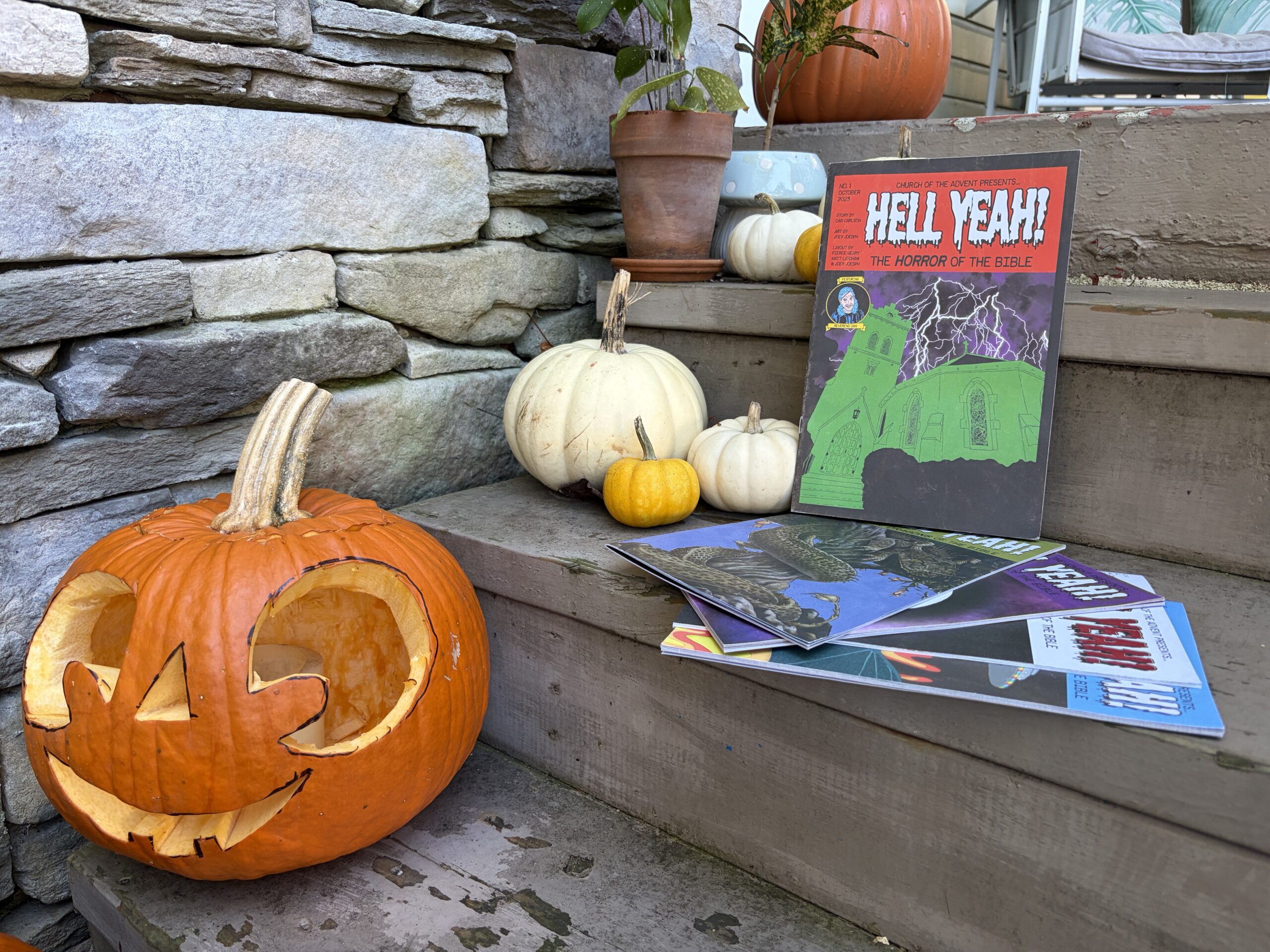
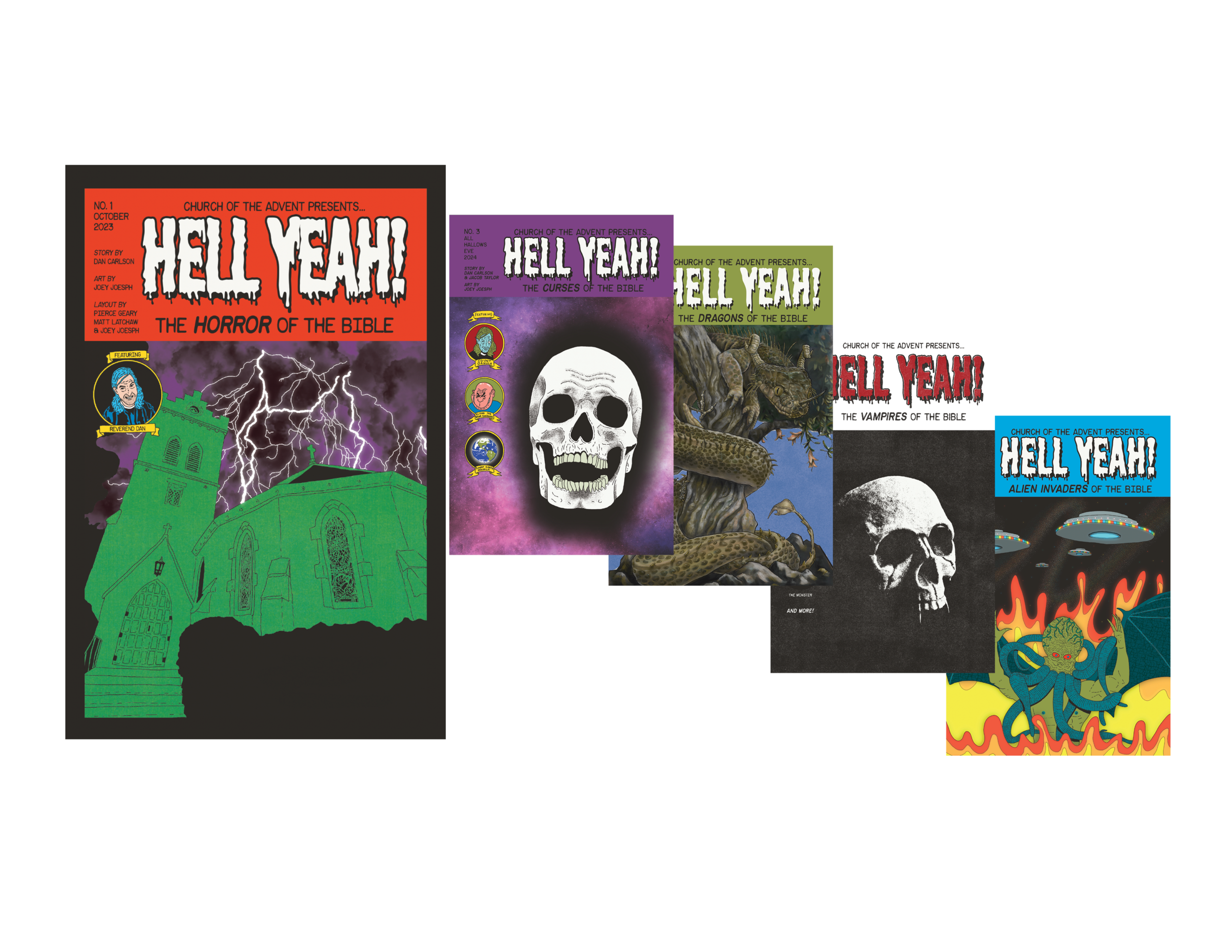
Exactly, which is quite appropriate. I mean, yeah, so that kind of brings me into the, you know, Hell Yeah! is the title of this magazine. There’s 5 volumes. Congratulations on the 5th volume just coming out. You guys have it in your hands for the first time. We just delivered it. So what was the spark for Hell Yeah!? Whose idea was it? And was there debate? How did the name come to be? You know.
Dan
Sure. I am probably most responsible. I will take full responsibility. I am the responsible one. I mean, there was an idea I told you about when I was in seminary and I was thinking about this. I had an idea for something kind of like this while I was in seminary. And it actually sort of grew out of the fact that before I went to seminary—well, I too was an art school kid, and I had sort of thought about comics and underground zines and things I had seen.
But before I set off for seminary, there was this idea that struck me. I had a couple of friends who were really in the practice of using the expression “hell yeah” when they were really excited about something. And I kept thinking about how kind of funny it was that you could use the word hell as an intensifier of the good. You know, that if something’s kind of good, yeah, but if it’s really, really good, hell yeah. And given the idea that hell in the Christian lexicon is this terrible dark awful image, the idea that somehow in our popular culture it can be used to intensify a good. I don’t know, something about that sort of stuck with me.
And so I had this thought about, what if we sort of created a zine or a comic book or something that sort of showed that principle at work on a larger scale rather than just in grammar. We actually tried to take those things, stories, symbols, particularly from the Bible, but also connecting those to stories and symbols in popular culture around us. And we tried to say, like, what would it mean to say say that God is somehow at work in spooky and terrible and horrifying stories and is using them as an intensifier of the good. So that was sort of the Genesis idea that sort of got us started.
A little bit of my personal biography is in the first issue of Hell Yeah! on this topic. I grew up in a pretty conservative evangelical household where it was drilled into my head that I was to stay as far as I could away from anything in the horror genre, that these things were of the devil, they were absolutely not for a good Christian boy to read. But I also spent a lot of hours in church and from an early age I learned how to find all the monsters in the Bible— all of the most gruesome battles, all of the murders happening in a tent, all this stuff that I found sort of interesting in the Bible, and yet I was being told Christians shouldn’t look at stories like that. So from a very early age, I can remember feeling this tension between horror or a sort of dark imagination and how that shows up in the Bible and what am I supposed to do with that? And that sort of was It’s the story that Hell Yeah!, sort of number one talks about is me as a kid sort of growing up.
It wasn’t actually supposed to be about me as a kid.
It was—this is a good way to bring Joey in. It was me sort of, I don’t know, writing my thoughts about it and referring in a couple of lines to my growing up experience. But then when you [Joey] came back with the drawings, it was me on the page telling it. It was me and it was my mom. I became a character, which was not really my plan, but that was sort of where you took it. So yeah, we can talk about how you sort of set the tone for visually what this was going to become.
Joey
Yeah, well, I mean, I thought, you know, reading the script, it was from your perspective, it was, you know, read like an essay, I think kind of like a first-person essay. And we talked a little bit about the EC horror comics and stuff, or at least I was thinking about that. And I think early on, as I was reading it, I was picturing like, it makes sense in my mind for this to be like a story kind of told from a narrator, like the Crypt Keeper or someone like that. And I remember asking Matt or you or someone like early on, like, because I had just met you, Dan. And so I was like, how do you think Dan would feel about being kind of like depicted as like a ghoulish, like minister, like an undead sort of like host, of this thing. Because, everyone, there are varying ideas of what is, of what’s, sacrilege is. And I was like, I don’t want to obviously push anything too far, do anything to whatever. But everyone seemed on board with Dan being this Crypt Keeper sort of character, and then also putting your head on a little kid’s body in that first issue. It’s a lot of fun.
Jason
They’re a lot of fun to read.
Jacob
I think like blue hair and a Metallica shirt.
Jason
I love it. I love it. So, I mean, you started to hit on it, the themes, the characters, the stories from the Bible, you’re bringing them out in a unique way. What do you hope that accomplishes for the reader, the end user who’s sitting down and maybe was also taught, don’t talk about these things? What do you hope that the readers, people who have these in their hands, what do you hope they’re taking away from it?
Dan
I think there’s a really bad tradition in the church of not knowing what to do. We create a sort of fictional construct of what the Bible ought to be, and then when it fails to live up to that fictional construct, we either awkwardly read around large parts of the text or experience a kind of embarrassment and try not to draw attention to it. Or the flip side of that is there’s no lack now of sort of like aggressive anti-church or anti-theist people who point to those texts as kind of proof that the Bible is a fundamentally corrupt project because have you seen what’s in it?
Boy, there’s a little bit of a list there, but I would probably put at the top of it, the idea of making everything in the Bible talk about-able.
So I think this idea that there are pieces that people in the church don’t talk about because they’re not sure what to do with it. It’s not only not serving Christians in the church, it’s also delegitimizing what we claim the Bible is in the eyes of others. And so I think the only serious path forward is for us to figure out what to do with the Bible, the actual Bible, not the imaginary one that we’ve made-up that doesn’t have this stuff in it, but the one which does.
And I think a big piece of that conversation is helped by the fact that for people who look at the Bible and they see these gruesome tales of murder or death or spirits or demons or whatever, and they see that as somehow disqualifying its spiritual value in the Bible. Frequently in our culture, those same people are spending money to watch horror movies and buy horror fiction, and they’re often forming very deep relationships to these works. They’re finding something really useful and meaningful in it. And so there’s some sort of chasm that has appeared between people’s ability to read the genre of horror and experience deep meaning through it, and their inability to do the same thing with the Bible, to read the genre of horror in the Bible and experience deep meaning through it.
So Hell Yeah! is on some level our very small and quirky attempt to start bridging that chasm and start bringing people back into the idea that the dark and disturbing content of the Bible may in fact not be some sort of dark secret best kept in the basement, but it might actually be something to be celebrated as a strength of the text.
Jason
Alright, so let’s get with Joey. You talked a little bit about the process, but what does it look like to start? Who starts it? Is it always a script first? Does Joey come with that? ideas, how does that work?
Dan
It more or less always starts with—the last few issues have started with me usually coming and sitting down with Jacob and saying, here’s the idea, do you think this is a bad idea? And we have a conversation about that and if I sort of get the thumbs up from Jacob thinking I’m not completely headed in the wrong direction, then I go and write a script and then at some point we send that script over to Joey to get his take on it.
And sometimes in that conversation then about what Joey’s seeing, what we’re seeing, the script will start to evolve a little bit. There’s definitely been a script or two where pretty late in the day, you and I were still sitting down looking at it and you were saying, Dan, the end doesn’t work. And I was saying, you’re absolutely correct. And we were having to like refigure kind of late in the process.
So some of them have come a little more, I guess, just sort of leapt out with very little problem in the birthing process. Others have put up more of a fight, but they all sort of follow that. There’s some sort of putting several ideas on the table, picking one of those, writing a script, seeing if that visually is of interest to you once we’re sort of conveying to you the direction we’re going with it, and then sort of, I guess, editing and massaging and tweaking and adjusting until we end up with something.
Well, there’s another piece of this too, which is that The Hell Yeah! Comics from the first year we did it, they’ve always been partnered with a live event that we do here at Church of the Advent. And so there’s also a sense in which we’re preparing that event, which we call every year “The Horror of the Bible,” where we have some sort of storytelling and music that is sort of themed around some horror genre that we are sort of talking about from the Bible. But the live event gives a chance so that if we have material that’s not working in the comic, I often can take that and rework it into the live event, which is a more expanded version of the same topic. So there’s a lot of back and forth between the script for the comic and the script for the live event and how these things in some ways track with each other and in some ways they diverge. So that’s also a key part of the creative process.
Jason
Joey, what does the artistic end of things look like? Do you sit down with a sketchbook first? Are you a computer animator? How do you create these?
Joey
Yeah, I get the script from Dan and Jacob. And I do it all digitally. There’s no initial paper stage, but I’ll have the text document and then I kind of, I start by going through and breaking it into what the pages will be, and kind of figuring out how many pages it’s going to be. And then I just start finish, just doing whole pages at a time, finishing a page before I move on to the next one.
The Bible is already, I feel like pretty visual, like explicitly visual. And then Dan’s writing is additionally visual, like his own context. And then there are a lot of notes included from Jacob that are like, it’d be cool if on this page, like this kind of thing was happening. And so a lot of kind of helpful input from them. And then, that’s pretty much.
Jason
Oh, they look great.
Joey
Yeah, thanks.
Dan
I would add to that though, that I mean, when we are choosing biblical quotations as part of the script—and we try to work quite a few of those in there—I’m often reaching for ones where I don’t want to give you too much instruction. Sometimes I’m throwing over to you. I’m just like, Ezekiel’s vision of God’s chariot. Go, bring something back to us.
There are so many things in the Bible that are just sort of strange symbolic texts in the poetry. And I have come to trust your judgment so deeply on what you’re going to do that sometimes I try to get out of your way. And I’m kind of like, if I can just find the right texts, toss them over to you— I’m very confident something extremely worthwhile is going to come back.
Joey
That’s really nice. I appreciate that.
And it is fun, particularly with things like Ezekiel’s chariot, where there are a lot of artistic depictions existing of some of these like more popular stories. So it’s fun to work with these guys and let my imagination wander, and try to come up with something— an interpretation that I haven’t seen somewhere, like a really buff bodybuilder driver of the chariot, or something like that. And it’s a lot of fun.
And then also, I feel like by the 5th issue now, I have a pretty good idea of what they’re going to be into or what they’re looking for. And then there were a small handful of images in this one and in issues past that I’m like, this could get hairy for whatever reason— mostly texting with Jacob being like, this is my first draft of this image. Is this too dark? Is this too upsetting? Is this communicating the right thing? What do you think?
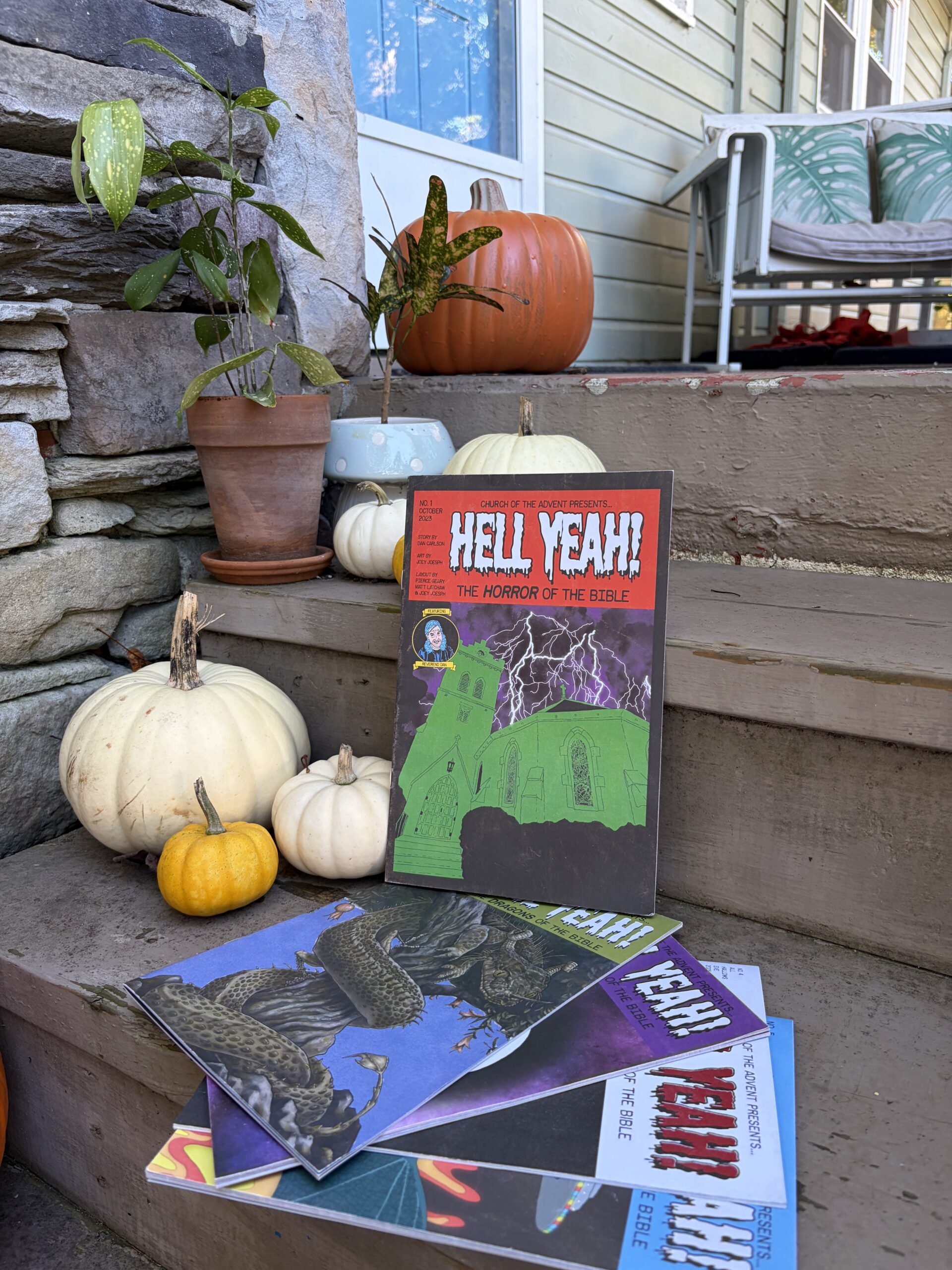
And Jacob is super helpful. Every once in a while he’ll be like, let me see what Dan thinks because this could get really sticky. So, which is cool to even be addressing that stuff. So kind of like head on that to be able to have those conversations. I mean, it’s been such a thought-provoking experience for me working on these. So yeah, I appreciate the whole experience very much.
Jason
What’s the reception been like, both at Advent and in your circles around outside of the congregation?
Jacob
Yeah, well, I think if people are having negative or critical thoughts about it, they’ve mostly kept it to themselves.
Jason
Rarely that happens. That doesn’t happen too often.
Jacob
I mean, overwhelmingly, people have been really enthusiastic about it, and it’s surprising and I think jolting enough to people that it’s just, there’s something magnetic about it. And I like the word “talk about-able.” I think people are hungry for this kind of material.
At least for me, and I think the story for a lot of people was just like, I mean, I grew up in the evangelical world, and these stories made sense of in a way that I found really unsatisfactory. And then being in more like progressive church settings, they’re kind of like shyly like pushed to the shadows, or not talked about, or kind of sentimentalized or whatever. And neither of those are helpful.
And I think we’re trying to create something that’s useful to people’s making sense of our sacred texts and images. It feels deeply important to talk really head on about these stories and symbols and images that are strewn throughout the Bible, at a time when people with less than savory sort of political motivations are more than ready to pick up these stories of conquest and exploitation, all these various things, to use and to provide some divine legitimation for their own projects.
We can’t not talk about this stuff. We have to talk about it. And I think people are attracted to it. And I don’t know if any other media projects that are doing this specific thing. And I think we’re scratching an itch. So all that is to say, overwhelmingly, I think the feedback has been pretty positive.
Dan
I think within the church, there’s been a very strong sense of eagerness and excitement. And our vestry has been excited about this. People have been taking extra copies to give to their friends.
We’ve seen a lot of conversation within the church— but in some ways even more exciting is the fact that, and now that we have the spinny rack, which was previously mentioned, this is even more true. But when we have these things out on tables in our church library and places like that, I regularly see people who are wandering through for some other event, some community event, who will walk past them stop, back up a couple steps, look again, then sort of sometimes they can’t get the courage up to actually pick one up, but when they do, often they walk away holding one or they look around to see if they’re supposed to be paying someone or when we’re like, you’re free to take one, they do.
And so we have a tendency to see people who are not necessarily of the church community who are sort of intrigued by these things and they end up carrying them away and distributing them. And these things keep escaping into the wild. And we hear back from people that have carried them into all sorts of places.
I mean, the one that actually gives me the most pause when you talk about reception is that we have, a time or two when we have put these out, felt the need to put a sign near them saying not for children. Because we have noticed that in church circles, there is a tendency sometimes you’re like, oh, it’s a church comic—my four-year-old will love this, and they’ll sort of reach for it. We have to be like, that’s not really the intended audience here. But I think weirdly outside of the church, comics are understood at this point enough as a medium that’s not child-facing inherently that people have a little more care when they open it up and see what they’re getting themselves into.
Jason
Great, great. So we’ve been talking about the Hell Yeah! comic series, but you have more. You’ve had up to 15 publications—Flowers as Teachers and others. Tell us a little bit about those other ones and what you aim to do with those.
Jacob
We’ve published a lot around the intersection of theology and ecology. When Dan and I started talking a couple years ago too, this was a thing that was really interesting to me, as Dan was articulating sort of his vision for this iteration of Advent’s life. Trying to build a community whose charism is really formed around these values of the arts and ecology. That was really interesting to me. I’d spent my grad school years kind of studying at that specific intersection.
So I think just naturally with some specific interest with those of us on staff, a good portion of our material has had sort of an environmental bit. That’s been one thing. We’ve published another zine on apophatic theology called Love is True Knowing. Our friend Lyric did the one that you mentioned called Flowers as Teachers, which is really beautiful.
Dan
And which is essentially about flower arranging as a prayer practice, you know, what that would look like.
Jacob
Yeah. What else have we done?
Dan
We’ve done some things around Lent and Advent, again, often with an ecological sort of theme to them. We recently did the one called Ordinary Time, which was sort of a collection of material from friends and community members and artists and thinkers that we’re in dialogue with, to sort of explore this notion of what does it mean to have a long green season of the church year that’s not necessarily about a dramatic single narrative, but it’s about something bigger.
I mean, one of the pieces that I think you’re highlighting though is that every zine we have done, I think, correct me if I’m wrong, but every zine we have done has grown out of some concrete. need of our community. And yet none of it has been done with a thought like this only makes sense in our community in light of this. But when you look at the ecological tone of a lot of our zines and then you walk around this church property, there’s a gigantic garden out front, there’s a lot of compost tumblers, there’s flowers and vegetables and an orchard going in. It looks like the kind of stuff you would find in a place like this.
And so it’s coming out of people putting these ideas into practice as well as trying to communicate the ideas and make the ideas beautiful. And our tendency to work with artists, and to reach for printers who are going to use interesting paper weights or printing techniques or stitched binding, this is reflected in the church where we have murals painted on the walls and we have community art projects going on.
So in some ways, Advent Workshop is very much an outgrowth of our parish life and the things we’re going, but there’s also this interesting way in which the parish life is giving birth to something that can sort of wander off into the broader world and still have a kind of integrity. But it’s not people abstractly wondering how these ideas might fit with the church. They’re growing out of our own attempts to embody them as best we can.
Jacob
Yeah, there’s a sort of organic way that these things are emerging. One example that comes to mind is we did a zine last year called Tour of the Torah. That emerged out of a connection I had with an old friend from high school who we didn’t keep up for years. His name’s Evan Bossman; we reconnected, I don’t know, five or six years ago at this point, through the climbing community, and we got to talking and he had gone on to do a PhD in Hebrew biblical studies. And we just got to talking over the years about his interests, and it just at one point it was just like, this would be really useful for our community to have sort of like a short primer on what is the Hebrew Bible, what is it doing, how is it structured? So we put that together, and that became the tour of the Torah. And those sorts of projects just emerge really naturally out of the very concrete relationships that we have.
And like down the street, one of our primary printers that we’ve used is a neighbor of ours. They’re called Cereal Box Studios. But they’re just up the street, and they’re really brilliant risograph printers. But those are friends from 10, 15 years ago in the music scene. So there’s just been a really cool way that like the relationships we’ve gathered both individually over our years living in Cincinnati and then over the past three years as this current manifestation of Advent. Yeah, there’s a cool, like very natural way that things are just kind of happening.
Dan
And to carry that principle forward—Advent Workshop, even though most of what we have done has been print zines, we’ve also done 2 cartoons at this point. And the animation projects have sort of grown out of a very organic relationship that we built with someone who showed up in our community who had this amazing skill set that was going underutilized. And we started thinking with them about what would it mean to create some cartoons to introduce the Episcopal understanding of the saints.
And so we’re slowly working on a series that’s called Cloud of Witnesses, which is sort of an animated introduction to saints in the Episcopal Church. But it’s again growing out of relationships and things that we have going on, conversations we have going on in the life of the church.
And then we’re moving in the coming year towards doing more music recording projects because this music is happening here in the church. It’s very central to a lot of our worship and the way we gather for events and concerts. And so we’re trying to think of ways of how that might show up and be shareable beyond our own specific context.
So everything sort of has its genesis in a particular parish trying to do things in a particular way, but we seem to be finding ways that you can sort of I guess bottle a little bit of that energy and creativity and give it to someone else and it can do them some good too.
Jason
You connected with Forward Movement, and now these zines are on our website and able to be reached by the whole church. Everyone can have these wonderful conversations.
So Jacob, Dan, Joey, thank you so much for your time today. And just to be sure, Advent Workshop’s going to continue. You’re going to keep making stuff?
Dan
Absolutely.
Jason
All right, well we hope to hear more from you soon about whatever’s around the bend. So thanks so much. And take care.
Jacob
Thanks. Thank you.