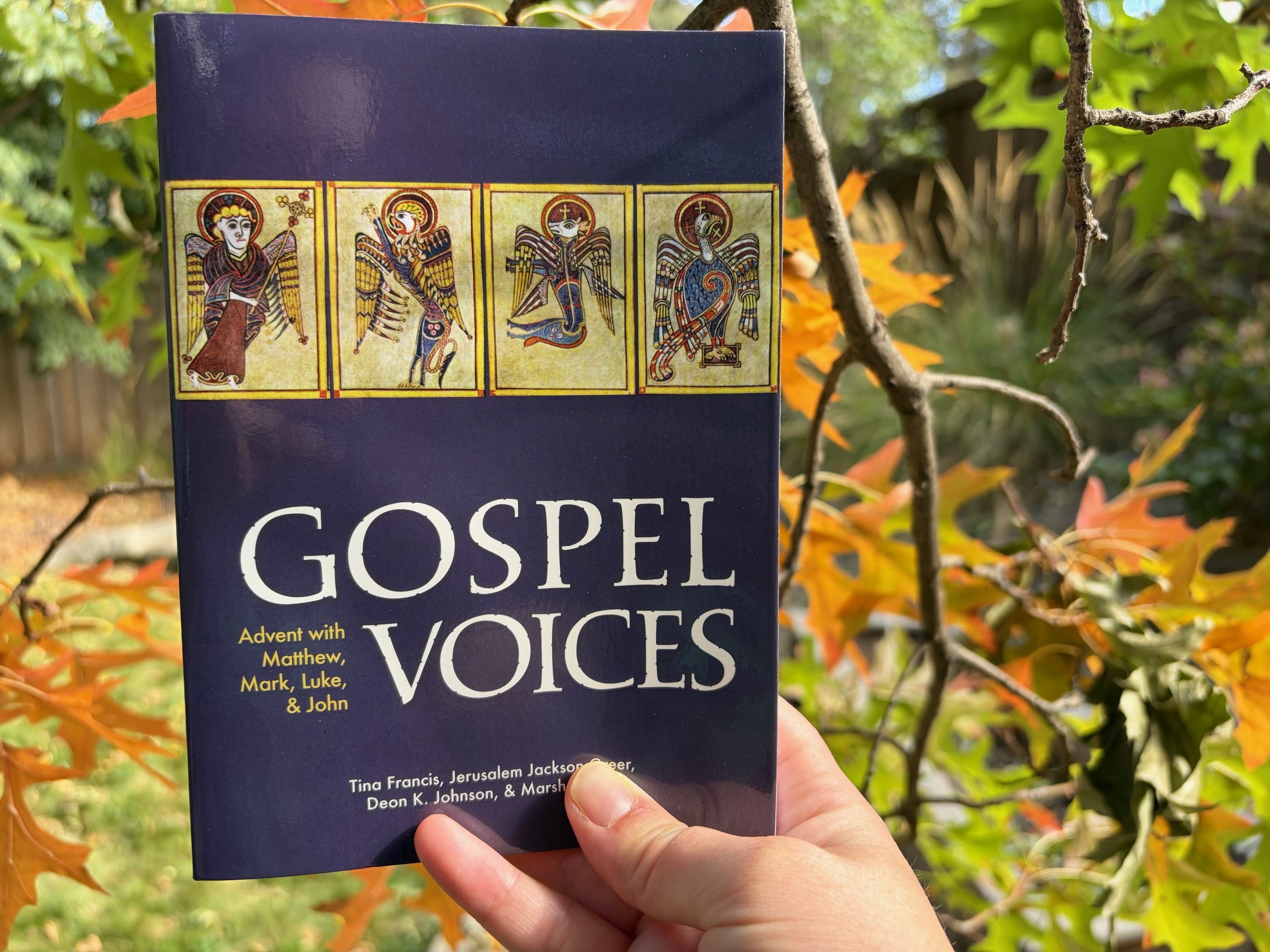
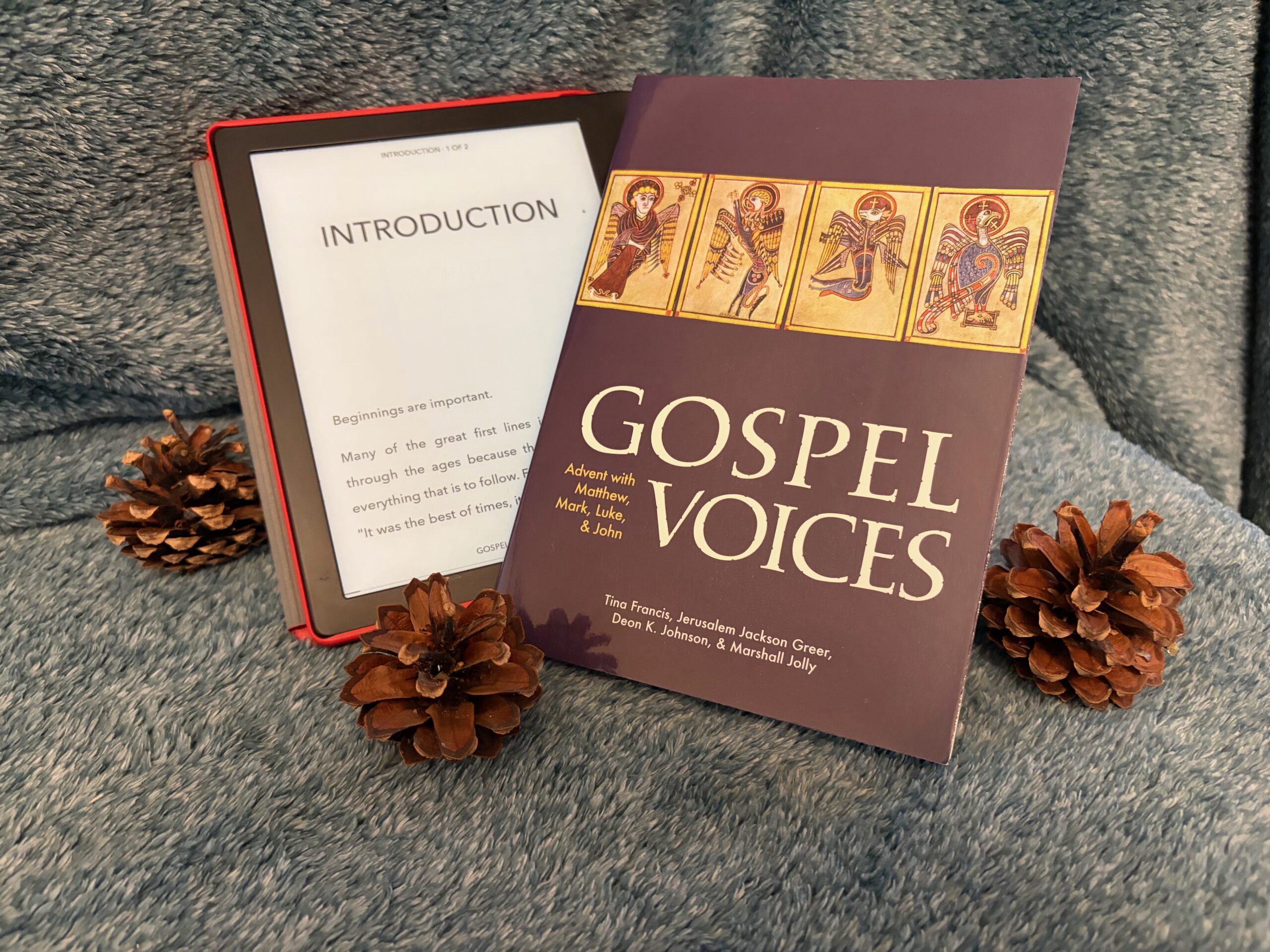
We’re less than a month away from Advent! Our newest devotional, Gospel Voices, invites you to enter into the sacred rhythm of the season through the voices of the four evangelists: Matthew, Mark, Luke, and John.
Today, we’d like to introduce you to the final of Gospel Voices’ four authors: Tina Francis (our guide for Matthew). Read Tina’s thoughts below, or catch up on the previous Q&As in this blog series. And don’t forget to order your copy of Gospel Voices from the Forward Movement website!
Tina Francis is a writer, photographer, and seminarian pursuing the priesthood in the Episcopal Church. Born to South Indian parents, raised in Dubai, shaped in Canada and Seattle, and now living in Austin, Texas, she carries many homes in her bones—an atlas of memory and migration.

How did you get started as a writer?
When I was young, I envied girls who had those little unicorn journals with the tiny locks and keys.
I wanted to be that kind of girl. A girl with pages and pages of private thoughts written in purple ink.
I was not that girl.
I grew up in a Catholic South Indian family in Dubai, where the notion of privacy was more of a fascinating Western phenomenon than an accepted cultural norm. My sister, my grandmother, and I shared a bedroom. In those close quarters, putting your private thoughts on paper seemed unwise.
I kept my journal in my head.
And honestly, I still think I had the right idea. People are out here reading Mother Teresa’s private journals and having the gall to then be disappointed in her. If Mother Teresa isn’t safe, none of us are.
So it is pretty strange that I done so much writing this past year. Writing required me to take the very things I had spent years keeping safely inside my head, put them into sentences, and hand them to strangers.
I started only because a friend launched an online magazine and badgered me into contributing.
“Just write about your life,” she said.
That was the door.
I did not have to begin with an Important Thought. I could begin with something that happened. Something I noticed. Something I did not yet understand.
So I wrote one piece. Then another. Eventually there were close to two hundred pieces, and years later that accidental writing life led to Bible Studies That Work, Forward Day by Day, and Gospel Voices.
Part of me is still the girl holding the beautiful empty unicorn journal.
Only now, every so often, I open it.
Put one honest thing on the page.
Let it live there.
Then risk another.
What was the most enjoyable part of the writing process?
Honestly? Having finished writing it. Ha.
The blank page is unnerving. But once I get past that, I love the act of looking.
Before seminary, I studied film, worked in television, and became a photographer. Photography taught me that the whole story is often hiding in some small, nearly ridiculous detail: a hand resting on a table, someone standing just outside the circle, the flicker of an expression before it disappears.
Writing feels like that to me.
I can begin with one small thing and stay with it long enough for it to deepen. The ordinary object becomes not so ordinary The strange thing becomes familiar. A detail opens, and suddenly there is a whole world inside it.
I come by some of that honestly as an Enneagram Four, which means I am constitutionally incapable of experiencing one emotion at a time. Joy arrives carrying melancholy. Grief keeps finding beauty beside it.
Exhausting in life.
Very useful for writing.
What about the most difficult part?
Getting past my inner critic long enough to make a first draft.
I had a terrible experience with academic writing when I first came to North America. I had been a straight-A student in a system that rewarded memorization. Then suddenly I was being asked for a thesis statement—the brilliant thing you apparently know before you have written the paper, followed by several orderly paragraphs proving how right you were to know it.
I rarely know the brilliant thing up front.
I begin with a hunch. A detail. A sentence I can’t quite shake. I circle it. I write three paragraphs that will eventually need to be put down humanely. Somewhere around page four, something begins to emerge.
Academic writing was not especially impressed by this method. I went from straight A’s to fighting for a C.
Still a C.
Nothing builds character quite like working extremely hard to achieve mediocrity.
So even now, the hardest part is trusting that I can write my way toward clarity.
Writing, for me, is often like wandering around the house looking for the glasses already sitting on my head.
And then, every so often, the thing I had only felt acquires edges.
Then a shape.
Then, finally, a name.
Where do you typically write?
At my desk.
I recently bought a very large monitor because I have officially reached the chapter of perimenopause where my eyes cooperate with only one font size: airport signage.
A desk is such an ordinary little place for a life to happen. You sit down. You move some words around. You drink something that has gone cold. You stare out the window. You come back. You try again.
And somehow, from that very small patch of wood and light, a whole interior world gets made visible.
Who is your favorite Gospel writer—and why?
Probably Luke.
I love how Luke centers the people who would be easy to miss: women, outsiders, the poor. His Gospel keeps turning the camera toward the ones everyone else has cropped out.
And Luke is so gloriously embodied. People are eating and traveling, touching and weeping, interrupting dinner and making a scene. God keeps arriving in bodies, at tables, on roads, in houses, in the middle of somebody’s actual life.
I love that.
The holy, in Luke, never stays abstract for long. It keeps putting on a body and walking into the room.
Do you have a favorite Advent or Christmas tradition?
I don’t know that I have one particular Advent ritual.
What I love is the honesty of the season.
The days shorten. Trees let go of what they cannot keep. Darkness comes early and stays. Advent does not rush to correct any of this.
Meanwhile, we are all out here frenetically stringing lights on things and buying peppermint-flavored everything and trying to generate a socially acceptable amount of joy.
And Advent says: You can be waiting. You can be tired. You can want something you cannot yet see.
And then, right there in the middle of all that not-yet-ness, somebody lights one tiny candle.
Which, oddly, feels like enough.
What moves me most: Advent does not deny the dark or ask us to manufacture hope. It teaches us to see that that even in the dark, life may already be preparing itself.
To learn more about this book or purchase a copy, visit our website.